Introduction
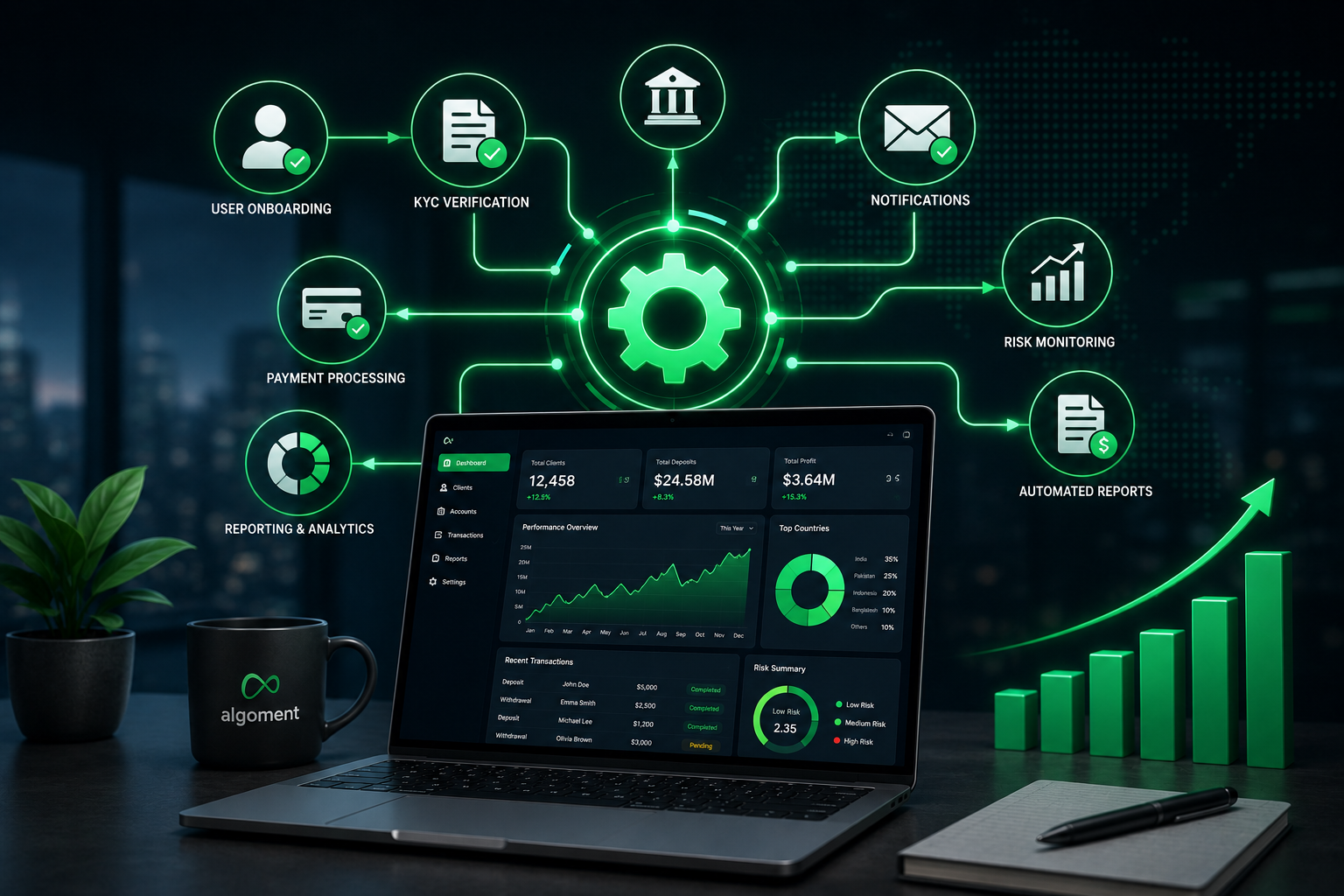
Financial businesses handle thousands of repetitive processes every day. Client onboarding, account updates, transaction processing, reporting, notifications, compliance checks, and data synchronization all require speed and accuracy.
Managing these processes manually becomes increasingly difficult as a business grows.
This is where automation in financial software becomes valuable.
Modern financial platforms can automate routine workflows, connect different systems, process information in real time, and help teams focus on decisions that actually require human expertise.
Automation is no longer simply about saving time. It has become an important part of building scalable, reliable, and efficient financial technology.
What Is Automation in Financial Software?
Financial software automation means using technology to perform predefined tasks and workflows with minimal manual intervention.
For example, when a client completes an action, the software can automatically trigger the next steps.
A simple workflow could look like this:
Client Registration → Identity Verification → Account Creation → CRM Update → Welcome Notification
Instead of employees manually completing each step, the system coordinates the process automatically.
The same principle can be applied across many financial operations.
Why Financial Businesses Need Automation
Financial companies often operate multiple systems at the same time.
These can include:
- CRM platforms
- Client portals
- Trading platforms
- Payment systems
- KYC services
- Accounting systems
- Risk management platforms
- Reporting tools
- Email and notification services
Without proper integration and automation, employees may have to transfer information manually between these systems.
That creates unnecessary work and increases the possibility of delays, inconsistent information, and human error.
Automation helps connect these systems into a more efficient digital ecosystem.
1. Automated Client Onboarding
Client onboarding is one of the first areas where automation can make a noticeable difference.
Instead of relying on emails and manual document processing, financial platforms can create structured onboarding workflows.
The system can automatically manage:
- Registration
- Email verification
- Document collection
- KYC submission
- Application status
- Account creation
- Client notifications
The result is a faster and more consistent onboarding experience.
2. KYC and Verification Workflows
Identity verification can involve multiple steps and external services.
Through API integrations, financial software can automatically send client information to verification providers, receive results, update the client’s status, and route exceptional cases for manual review.
This creates an important balance.
Automation handles routine cases while compliance teams remain responsible for situations requiring human judgment.
3. Payment and Transaction Automation
Financial platforms process large numbers of transaction-related events.
Automation can help coordinate:
- Deposit requests
- Payment confirmations
- Withdrawal workflows
- Internal transfers
- Transaction status updates
- Wallet balances
- Notifications
For example, after receiving confirmation from a payment provider, the platform can automatically update the transaction status and notify the appropriate systems.
This reduces unnecessary manual processing while keeping financial records synchronized.
4. Automated Reporting
Preparing operational reports manually can consume significant time.
Modern financial software can automatically collect information from multiple data sources and transform it into dashboards and reports.
Management teams can monitor areas such as:
- Client activity
- Transaction volumes
- Revenue
- Operational performance
- Trading activity
- Risk indicators
- Sales performance
Instead of waiting for someone to prepare a spreadsheet, decision-makers can access updated information directly from their dashboard.
5. Real-Time Alerts and Notifications
Automation becomes particularly useful when businesses need to respond quickly to important events.
A platform can monitor predefined conditions and trigger alerts when something requires attention.
Examples include:
- Unusual account activity
- Large transactions
- Failed payments
- Risk thresholds
- System errors
- Account status changes
- Important client actions
Alerts can then be delivered through dashboards, email, SMS, or other communication channels.
This allows teams to focus on important events rather than continuously monitoring every system manually.
6. Automation in Trading and Brokerage Technology
Automation is especially important in trading technology, where information can change within seconds.
Brokerage platforms may need to synchronize information between trading servers, CRMs, client portals, and risk management systems.
Automation can support workflows involving:
- Trading account creation
- Account balance synchronization
- Trade data synchronization
- Client portal updates
- Exposure monitoring
- Risk alerts
- IB commission calculations
- Performance reporting
Real-time connections help different parts of the brokerage infrastructure operate as one connected system.
7. Automated Risk Monitoring
Risk teams need access to accurate information without unnecessary delays.
Modern risk management platforms can continuously analyze data and automatically detect conditions requiring attention.
For example, a system may monitor:
Exposure → Margin → Equity → P&L → Concentration → Risk Thresholds
When predefined thresholds are reached, alerts can be generated immediately.
Automation doesn’t replace risk managers. Instead, it gives them faster access to relevant information so they can make better-informed decisions.
8. CRM and Sales Automation
Automation is also valuable outside financial transactions.
A financial CRM can automatically manage parts of the sales process, including:
- Lead capture
- Lead assignment
- Follow-up reminders
- Client segmentation
- Email notifications
- Sales pipeline updates
- Conversion tracking
This allows sales teams to spend less time managing records and more time communicating with potential clients.
9. Connecting Financial Systems Through APIs
Automation becomes much more powerful when different applications can communicate with each other.
APIs can connect:
CRM ↔ Client Portal ↔ Trading Platform ↔ Payments ↔ KYC ↔ Risk Management
Instead of maintaining isolated applications, businesses can create a connected financial technology ecosystem.
For example, a change made in one system can automatically trigger an update in another.
This reduces duplicate work and helps maintain consistent information across the platform.
10. AI and the Next Generation of Automation
Artificial intelligence is expanding what financial software automation can achieve.
Traditional automation usually follows predefined rules:
If X happens → perform Y.
AI-powered systems can go further by analyzing patterns and assisting with more complex processes.
Potential applications include:
- Anomaly detection
- Intelligent document processing
- Data classification
- Predictive analytics
- Customer support assistance
- Risk pattern identification
- Operational insights
The combination of AI and workflow automation can help financial companies build increasingly intelligent software systems.
Security Must Come First
Automation should never come at the expense of security.
Financial platforms should be designed with appropriate controls such as:
- Role-based access
- Multi-factor authentication
- Data encryption
- Secure API authentication
- Audit logs
- Approval workflows
- Activity monitoring
- Rate limiting
- Backup and recovery procedures
Sensitive actions should also include human approval where appropriate.
Good automation doesn’t remove control. It creates structured processes with better visibility and accountability.
The Business Benefits of Financial Automation
When implemented correctly, automation can provide significant operational advantages:
- Reduced repetitive work
- Faster processing
- Fewer manual errors
- Improved data consistency
- Better customer experience
- Real-time visibility
- Easier scalability
- Improved operational efficiency
Most importantly, automation allows teams to concentrate on higher-value activities rather than routine administrative tasks.
How Algoment Builds Automated Financial Solutions
At Algoment, we design and develop financial technology solutions that connect complex business processes into streamlined digital workflows.
Our development capabilities include:
- Financial workflow automation
- Custom CRM development
- Client and IB portals
- MT4 & MT5 integrations
- Risk management platforms
- Copy trading solutions
- API development and integration
- Real-time dashboards
- Payment integrations
- AI-powered financial applications
- Custom fintech software
Rather than simply digitizing existing processes, the goal is to identify where technology can reduce unnecessary manual work and create a more scalable infrastructure.
Final Thoughts
The future of financial software is increasingly automated, connected, and data-driven.
Businesses that continue relying heavily on disconnected systems and repetitive manual processes can find it difficult to scale efficiently.
Well-designed automation changes this by connecting applications, synchronizing information, monitoring important events, and automatically managing repetitive workflows.
However, successful automation isn’t about automating everything.
It is about automating the right processes while keeping people in control of the decisions that matter.
For financial businesses looking to modernize their technology infrastructure, intelligent automation can provide the foundation for faster operations, improved scalability, and better digital experiences.